"DEATH COMES TO GRAND GOAVE" DUE TO HURRICANE SANDY
(www.theawkwardpose.com) -
Death comes to Haiti so arbitrary it shatters any illusion that we control
our destiny. Hurricane Sandy is on her third day of delivering heavy rain
to Grand Goave. Unlike Isaac, who quickly shuffled through his fierce
gales and heavy rains, Sandy lacks bluster yet drenches us with swirling
clouds that refuse to spin away. Perhaps she lingers to visit her little
black namesake at the bottom of our hill. Perhaps she wants us to
reconsider the wisdom of constructing a building so heavy it cannot move
when an arc might serve us better. Perhaps she wants to demonstrate the
destructive power of the slow moving tortoise over the quick fleeting
hare. Sandy has already rendered more damage than Isaac, though her skies
show no sign of clearing.
This morning five people in Grand Goave died from Hurricane Sandy; a
landslide down the mountain next to Be Like Brit smothered a tent where a
mother and her four children slept in one bed. They were buried alive.
When Francky and Gilbert ran to the scene I considered joining, but thought
better of it. Though I add value in areas of design, direction and
analysis, I am useless at tasks requiring brute strength, like digging
through muddy remains. The few corpses I have seen in my sheltered life
have all been neatly composed in coffins. Corpses here are much more
common, yet rarely so well preserved.
According to the World Bank, the average life expectancy for a baby born in
Haiti in 2012 is 60.6 years, but that statistic does not jive with anyone's
experience living here. Making it past sixty in Haiti is not the norm, it
is a rare achievement. People who are thriving and vigorous one day are
gone the next. Tragedy is the norm. People mourn untimely deaths with loud
flamboyance, then quickly return to their daily rhythms. If people lingered
in grief, their grief would be perpetual.
In a typical year in the United States I might hear of a few people who
have died; most all of them after a full life. In my regular visits to
Haiti I learn about someone who dies every month. Here is a
representative list from 2012; I imagine anyone else in this fragile
country could give a similar accounting.
Dieunison's mother died at the beginning of the year. She was reportedly a
voodoo priestess, like her mother before her. I have never heard anyone
mention her cause of death, though she could not have been very old.
In February an elderly woman was hit by a motorcycle near MoHI's gate.
Gama, who is a paramedic, rushed to the scene and collected her to the
hospital, but the woman did not survive.
In March Gama's cousin died, a thirty-three year old woman with a husband
and three children. She had a short, fatal illness though I never heard a
diagnosis.
Marieve's cousin died in child birth in April. She is survived by a
husband, young son and twin daughters, one of whom was born blind.
In May Pepe's father-in-law died. He at least had a long life.
Three local youths died in a horrendous wreck when their small car was run
into a ditch by an out of control truck in June. The truck's chassis
ploughed right over the car, crushing and killing them on the spot.
In July Lex's sister-in-law died; age 42.
August was a month when horror visited children. A six year old Hands and
Feet orphan drowned in the Caribbean Sea. After searching for hours, the
matrons gave up when night fell. The girl?s body was discovered the next
day, her extremities gone. The same month Kylene, a MoHI Sunday singer,
lost her third baby in four pregnancies. The baby was full term, yet born
dead.
I hoped that September would break the pattern; but all kinds of odd
disease flourished. Toto had a wound on his arm that blistered and sent him
to the hospital; he missed three weeks of work. Ble, the painter, got a
cut on his leg that festered into an ugly infection. He limped around the
site for days with his pants leg rolled up so fresh air could scab over the
oozing pus, but with so much plaster dust in the air his leg healed
slowly. Fanes came down with a stomach bug, the front end version of what
plagued me, but in a more severe form. He could not keep any food down,
lost sixty pounds and moved to Les Cayes where his family could care for
him. Two days after I returned to the States Fanes died. Dysentery?
Worms? Whatever took this healthy man in his middle forties was likely
something that could have been diagnosed and treated in any industrial
nation.
When I return this month a banner in the crew's lunch tent honors Boss
Fanes, but in truth, I have not heard his name mentioned even once. Two
weeks after passing, life without Fanes is the new normal; everyone has
moved on.
There is no time to grieve for Fanes, or the drowned girl, or Pepe's
father-in-law, or Dieunison's mother because today we have a new tragedy,
five bodies lying together wrapped in a USAID tarp. Lex prays over them
while a crowd of Haitians in ponchos and ripped garbage bags witness their
passing before Hurricane Sandy even departs our shores.
At least half these people who died this year could have been saved by
elementary public health measures - clean water, safe houses, vehicle
inspections, maternity care, life guards. We take these for granted in the
United States and other developed countries. But for nine million
Haitians, and a billion others around the planet, these simple safeguards
do not exist. So people continue to die from landslides and labor;
dysentery and drowning; and as long as we allow these conditions to prevail
for our fellow humans, our society is less developed than we pretend.
Monday, October 29, 2012

ARTICLE - SANDY DESTROYS LIVES AND PROPERTY
DEVASTATING HURRICANE SANDY SLAMS INTO HAITI DESTROYING LIVES AND PROPERTY
(Guardian Express) - Devastation slams into Haiti as life and property are destroyed by Hurricane Sandy. In the midst of the destruction, a nationwide damage assessment in Haiti authorities say 44 have died from Hurricane Sandy?s torrential winds.
As Prime Minister Laurent Lamothe of Haiti peered from the helicopter window he paused, as if needing time to process the ravaged landscape below: washed-out roads, rotting crops, flooded roads and raging rivers flowing with mud.
"We have a big job to do,?" Lamothe said to Sen. Steven Benoit, a member of the opposition party, who was along on a grim damage survey Saturday.
With the death toll rising to at least 44 and an estimated 200,000 homeless as a result of four days of relentless rain from Hurricane Sandy, Lamothe appealed for patience and called for investment in flood-control structures that are largely absent from the countryside. But he also expressed a weary frustration, one shared by many in this poor nation reeling from a string of natural disasters. With each one, he said, Haiti has taken a step backward.
"It should not be normal that every time it rains, we have a catastrophe throughout the country," Lamothe said.
As Haiti began what will be grueling months of cleanup from a powerful Category 2, 115-mph hurricane that left a trail of destruction and killed at least 57 people in the Caribbean, millions of people in the northeastern United States were bracing for what meteorologists and emergency managers fear could be a disaster of epic proportions.
Nine states called out the National Guard in preparation for the aftermath that Craig Fugate, director of the Federal Emergency Management Agency, said Saturday could hammer an 800-mile swath of the country from North Carolina to Maine with a messy mix of intense rains, storm surge heightened by extreme tides, gale-force winds and up to two feet of snow in some states.
Fugate, director of the Federal Emergency Management Agency, said it was too soon to say which states were going to get the worst weather but the storm could affect a huge swath of the Northeast ? and not just along the coast. West Virginia, for instance, could see two feet of snow and flooding rains, and damaging winds could reach Ohio, he said during a conference call Saturday.
"We need to make sure people understand that this is going to go well inland," Fugate said.
Rick Knabb, director of the National Hurricane Center in West Miami-Dade, said Sandy?s wind field is so massive that conditions will begin deteriorating this week along the Outer Banks of North Carolina, even though the center of the storm makes landfall possibly near the coast of Delaware and New Jersey late Monday or early Tuesday.
Hurricane Sandy was expected to mesh with two winter weather systems as it moves inland, creating a super-storm some experts fear could prove more costly than Hurricane Irene, which hit the same area last year and caused more than $15 billion in damage.
In Haiti, the United Nations and the Haitian government were trying to put a price on the loss, but it will be an arduous process with many areas isolated by impassable roads. Once again, it had not taken a direct hit from a tropical storm to wreck Haiti; the core of Sandy, like Isaac earlier this year, had skirted the country.
The Office of Civil Protection raised the total of known dead in Haiti on Saturday to 44, with at least 12 missing and 19 injured. More than 21,107 were in shelters and an estimated 200,000 were homeless after the storm in a country where more than 350,000 are still homeless after a devastating earthquake in 2010.
Along Haiti's hard-hit southern coast, no community seemed to have been spared. From the air, coconut trees looked like wet mops, large farms stood in pools of water and eroded soil from the denuded hillsides turned the sea the color of mocha.
Haitians were caught off guard by what some are calling ?the Caribbean storm? because it came from the sea to the south, not out of the Atlantic Ocean.
The storm, say Haitian and international aid officials, dumped more rain than Tropical Storm Isaac in August and Tomas in 2010 after the earthquake.
In the city of Les Cayes, among the hardest-hit areas, the storm dumped a stunning 27 inches of rain in a 24-hour period, said Johan Peleman, director of the United Nations humanitarian agency in Haiti.
In areas the government and aid agencies could reach, thousands of hot meals were to be distributed, Lamothe said.
"Given the situation we are living today, it will not be easy," he said. "We need the patience of everyone. We will not be able to get to everyone at the same time."
Lamothe said the government plans to launch a country-wide retaining wall project to protect villages built along rivers criss-crossing the mountainous nation.
In some communities like Leogane, rivers were still rising from flood water spilling down from the hills.
"People cannot think that everything is over. Things are not over yet," said Benoit, who invited himself on the helicopter tour. "This is a national problem."
The NHC said the hurricane will move parallel to the southeast coast of the United states during the weekend.
In Cuba, powerful winds and torrential rains associated with Sandy destroyed or damaged thousands of homes, stores, warehouses and plantations, mainly in Santiago de Cuba and Holguin.
From North Carolina to the coastal edges of Maine, public officials urged residents to fortify themselves against Hurricane Sandy, which is expected to unleash torrential rains and winds of up to 75 mph, even for those residing as far as 100 miles from the storm?s center.
State and federal officials are planning for several days of treacherous conditions throughout the Mid-Atlantic States. As much as 8 inches of rain is expected to hit those states. In addition, two feet of snow will perhaps bury mountain areas inn North Carolina, Virginia and West Virginia.
(Guardian Express) - Devastation slams into Haiti as life and property are destroyed by Hurricane Sandy. In the midst of the destruction, a nationwide damage assessment in Haiti authorities say 44 have died from Hurricane Sandy?s torrential winds.
As Prime Minister Laurent Lamothe of Haiti peered from the helicopter window he paused, as if needing time to process the ravaged landscape below: washed-out roads, rotting crops, flooded roads and raging rivers flowing with mud.
"We have a big job to do,?" Lamothe said to Sen. Steven Benoit, a member of the opposition party, who was along on a grim damage survey Saturday.
With the death toll rising to at least 44 and an estimated 200,000 homeless as a result of four days of relentless rain from Hurricane Sandy, Lamothe appealed for patience and called for investment in flood-control structures that are largely absent from the countryside. But he also expressed a weary frustration, one shared by many in this poor nation reeling from a string of natural disasters. With each one, he said, Haiti has taken a step backward.
"It should not be normal that every time it rains, we have a catastrophe throughout the country," Lamothe said.
As Haiti began what will be grueling months of cleanup from a powerful Category 2, 115-mph hurricane that left a trail of destruction and killed at least 57 people in the Caribbean, millions of people in the northeastern United States were bracing for what meteorologists and emergency managers fear could be a disaster of epic proportions.
Nine states called out the National Guard in preparation for the aftermath that Craig Fugate, director of the Federal Emergency Management Agency, said Saturday could hammer an 800-mile swath of the country from North Carolina to Maine with a messy mix of intense rains, storm surge heightened by extreme tides, gale-force winds and up to two feet of snow in some states.
Fugate, director of the Federal Emergency Management Agency, said it was too soon to say which states were going to get the worst weather but the storm could affect a huge swath of the Northeast ? and not just along the coast. West Virginia, for instance, could see two feet of snow and flooding rains, and damaging winds could reach Ohio, he said during a conference call Saturday.
"We need to make sure people understand that this is going to go well inland," Fugate said.
Rick Knabb, director of the National Hurricane Center in West Miami-Dade, said Sandy?s wind field is so massive that conditions will begin deteriorating this week along the Outer Banks of North Carolina, even though the center of the storm makes landfall possibly near the coast of Delaware and New Jersey late Monday or early Tuesday.
Hurricane Sandy was expected to mesh with two winter weather systems as it moves inland, creating a super-storm some experts fear could prove more costly than Hurricane Irene, which hit the same area last year and caused more than $15 billion in damage.
In Haiti, the United Nations and the Haitian government were trying to put a price on the loss, but it will be an arduous process with many areas isolated by impassable roads. Once again, it had not taken a direct hit from a tropical storm to wreck Haiti; the core of Sandy, like Isaac earlier this year, had skirted the country.
The Office of Civil Protection raised the total of known dead in Haiti on Saturday to 44, with at least 12 missing and 19 injured. More than 21,107 were in shelters and an estimated 200,000 were homeless after the storm in a country where more than 350,000 are still homeless after a devastating earthquake in 2010.
Along Haiti's hard-hit southern coast, no community seemed to have been spared. From the air, coconut trees looked like wet mops, large farms stood in pools of water and eroded soil from the denuded hillsides turned the sea the color of mocha.
Haitians were caught off guard by what some are calling ?the Caribbean storm? because it came from the sea to the south, not out of the Atlantic Ocean.
The storm, say Haitian and international aid officials, dumped more rain than Tropical Storm Isaac in August and Tomas in 2010 after the earthquake.
In the city of Les Cayes, among the hardest-hit areas, the storm dumped a stunning 27 inches of rain in a 24-hour period, said Johan Peleman, director of the United Nations humanitarian agency in Haiti.
In areas the government and aid agencies could reach, thousands of hot meals were to be distributed, Lamothe said.
"Given the situation we are living today, it will not be easy," he said. "We need the patience of everyone. We will not be able to get to everyone at the same time."
Lamothe said the government plans to launch a country-wide retaining wall project to protect villages built along rivers criss-crossing the mountainous nation.
In some communities like Leogane, rivers were still rising from flood water spilling down from the hills.
"People cannot think that everything is over. Things are not over yet," said Benoit, who invited himself on the helicopter tour. "This is a national problem."
The NHC said the hurricane will move parallel to the southeast coast of the United states during the weekend.
In Cuba, powerful winds and torrential rains associated with Sandy destroyed or damaged thousands of homes, stores, warehouses and plantations, mainly in Santiago de Cuba and Holguin.
From North Carolina to the coastal edges of Maine, public officials urged residents to fortify themselves against Hurricane Sandy, which is expected to unleash torrential rains and winds of up to 75 mph, even for those residing as far as 100 miles from the storm?s center.
State and federal officials are planning for several days of treacherous conditions throughout the Mid-Atlantic States. As much as 8 inches of rain is expected to hit those states. In addition, two feet of snow will perhaps bury mountain areas inn North Carolina, Virginia and West Virginia.
ARTICLE - UTAH MEDICAL TEAM TRIP TO HAITI
HUMANITARIAN TRIP TO HAITI IS BACK ON FOR A GROUP OF UTAH DOCTORS
(ABC4) - By Brian Carlson
SALT LAKE CITY - A group of Utah doctors thought Hurricane Sandy had canceled their humanitarian trip to Haiti, but Saturday night they decided they're not let Mother Nature get in their way.
Joel Porter's bags are packed and he's ready to go.. again.
"It's quite a relief that we're going to be able to go," said Joel Porter, M.D.
Dr. Porter is part of a group of 16 Utahns with the Haiti Health Initiative leaving Saturday night to Haiti. They're providing free medical care to some of the Caribbean country's most impoverished areas.
But it almost didn't happen.
"The reports came in that the clinic was pretty much destroyed," said Porter.
When Hurricane Sandy hit Haiti, it wiped out the group's medical facilities. Dr. Porter, Dr. Wood, their two daughters and others were forced to accept the trip was over.
"It was very disappointing," said Emily Porter, Joel Porter's daughter.
"We have some people there that we're their only health care they'll get, and the thought of not being able to be there for them was really difficult," said Tom Wood, M.D.
But just hours after canceling their plans, the group learned people in Haiti had worked feverishly to repair damage to the treatment center, and Haitians encouraged them to keep the trip alive.
"They worked really hard, and told us we could still make a difference," said Porter.
So with the threat of the storm gone and the promise they can still treat patients, the group the going again. And they're hoping this time a luck is on their side.
"Are you crossing your fingers this time?"asked Reporter Brian Carlson.
"Yup, I think it'll work out alright," said Sabrina Wood, Tom Wood's daughter.
(ABC4) - By Brian Carlson
SALT LAKE CITY - A group of Utah doctors thought Hurricane Sandy had canceled their humanitarian trip to Haiti, but Saturday night they decided they're not let Mother Nature get in their way.
Joel Porter's bags are packed and he's ready to go.. again.
"It's quite a relief that we're going to be able to go," said Joel Porter, M.D.
Dr. Porter is part of a group of 16 Utahns with the Haiti Health Initiative leaving Saturday night to Haiti. They're providing free medical care to some of the Caribbean country's most impoverished areas.
But it almost didn't happen.
"The reports came in that the clinic was pretty much destroyed," said Porter.
When Hurricane Sandy hit Haiti, it wiped out the group's medical facilities. Dr. Porter, Dr. Wood, their two daughters and others were forced to accept the trip was over.
"It was very disappointing," said Emily Porter, Joel Porter's daughter.
"We have some people there that we're their only health care they'll get, and the thought of not being able to be there for them was really difficult," said Tom Wood, M.D.
But just hours after canceling their plans, the group learned people in Haiti had worked feverishly to repair damage to the treatment center, and Haitians encouraged them to keep the trip alive.
"They worked really hard, and told us we could still make a difference," said Porter.
So with the threat of the storm gone and the promise they can still treat patients, the group the going again. And they're hoping this time a luck is on their side.
"Are you crossing your fingers this time?"asked Reporter Brian Carlson.
"Yup, I think it'll work out alright," said Sabrina Wood, Tom Wood's daughter.
ARTICLE - HURRICANE'S DEATH TOLL RISES - 65
HURRICANE SANDY'S DEATH TOLL RISES TO 65 AS FLOODING CONTINUES IN HAITI
(Newser) - by Trenton Daniel (AP)
Hurricane's death toll rises to 65 in Caribbean
As Americans braced Sunday for Hurricane Sandy, Haiti was still suffering.
Officials raised the storm-related death toll across the Caribbean to 65, with 51 of those coming in Haiti, which was pelted by three days of constant rains that ended only on Friday.
As the rains stopped and rivers began to recede, authorities were getting a fuller idea of how much damage Sandy brought on Haiti. Bridges collapsed. Banana crops were ruined. Homes were underwater. Officials said the death toll might still rise.
"This is a disaster of major proportions," Prime Minister Laurent Lamothe told The Associated Press, adding with a touch of hyperbole, "The whole south is under water."
The country's ramshackle housing and denuded hillsides are especially vulnerable to flooding. The bulk of the deaths were in the southern part of the country and the area around Port-au-Prince, the capital, which holds most of the 370,000 Haitians who are still living in flimsy shelters as a result of the devastating 2010 earthquake.
Santos Alexis, mayor of the southern city of Leogane, said Sunday that the rivers were receding and that people were beginning to dry their belongings in the sun.
"Things are back to being a little quiet," Alexis said by telephone. "We have seen the end."
Sandy also killed 11 in Cuba, where officials said it destroyed or damaged tens of thousands of houses. Deaths were also reported in Jamaica, the Bahamas and Puerto Rico. Authorities in the Dominican Republic said the storm destroyed several bridges and isolated at least 130 communities while damaging an estimated 3,500 homes.
Jamaica's emergency management office on Sunday was airlifting supplies to marooned communities in remote areas of four badly impacted parishes.
In the Bahamas, Wolf Seyfert, operations director at local airline Western Air, said the domestic terminal of Grand Bahamas' airport received "substantial damage" from Sandy's battering storm surge and would need to be rebuilt.
(Newser) - by Trenton Daniel (AP)
Hurricane's death toll rises to 65 in Caribbean
As Americans braced Sunday for Hurricane Sandy, Haiti was still suffering.
Officials raised the storm-related death toll across the Caribbean to 65, with 51 of those coming in Haiti, which was pelted by three days of constant rains that ended only on Friday.
As the rains stopped and rivers began to recede, authorities were getting a fuller idea of how much damage Sandy brought on Haiti. Bridges collapsed. Banana crops were ruined. Homes were underwater. Officials said the death toll might still rise.
"This is a disaster of major proportions," Prime Minister Laurent Lamothe told The Associated Press, adding with a touch of hyperbole, "The whole south is under water."
The country's ramshackle housing and denuded hillsides are especially vulnerable to flooding. The bulk of the deaths were in the southern part of the country and the area around Port-au-Prince, the capital, which holds most of the 370,000 Haitians who are still living in flimsy shelters as a result of the devastating 2010 earthquake.
Santos Alexis, mayor of the southern city of Leogane, said Sunday that the rivers were receding and that people were beginning to dry their belongings in the sun.
"Things are back to being a little quiet," Alexis said by telephone. "We have seen the end."
Sandy also killed 11 in Cuba, where officials said it destroyed or damaged tens of thousands of houses. Deaths were also reported in Jamaica, the Bahamas and Puerto Rico. Authorities in the Dominican Republic said the storm destroyed several bridges and isolated at least 130 communities while damaging an estimated 3,500 homes.
Jamaica's emergency management office on Sunday was airlifting supplies to marooned communities in remote areas of four badly impacted parishes.
In the Bahamas, Wolf Seyfert, operations director at local airline Western Air, said the domestic terminal of Grand Bahamas' airport received "substantial damage" from Sandy's battering storm surge and would need to be rebuilt.
ARTICLE - STORM DAMAGES CROPS IN HAITI
STORM DAMAGES CROPS IN HAITI, FUELING FOOD PRICE WOES
(Reuters) - By Susana Ferreira
PORT-AU-PRINCE - As Hurricane Sandy barreled toward the U.S. East Coast on Monday, the full extent of the storm's havoc on Haiti was just beginning to emerge.
Extensive damage to crops throughout the southern third of the country, as well as the high potential for a spike in cases of cholera and other water-borne diseases, could mean Haiti will see the deadliest effects of Sandy in the coming days and weeks.
Haiti reported the highest death toll in the Caribbean, as swollen rivers and landslides claimed at least 52 lives, according to the country's Civil Protection office. More than three days of constant rain left roads and bridges heavily damaged, cutting off access to several towns and a key border crossing with the Dominican Republic.
"The economy took a huge hit," Prime Minister Laurent Lamothe told Reuters. He also said Sandy's impact was devastating, "even by international standards," adding that Haiti was planning an appeal for emergency aid.
"Most of the agricultural crops that were left from Hurricane Isaac were destroyed during Sandy," he said, "so food security will be an issue."
Sandy also destroyed banana crops in eastern Jamaica as well as decimating the coffee crop in eastern Cuba.
But the widespread loss of crops and supplies in the south, both for commercial growers and subsistence farmers, is what has Haitian authorities and aid organizations had worried about most.
The past several months have seen a series of nationwide protests and general strikes over the rising cost of living. Even before Hurricane Sandy hit, residents complained that food prices were too high.
PEASANT CROP LOSSES
A rise in food prices in Haiti triggered violent demonstrations and political instability in April 2008. Jean Debalio Jean-Jacques, the Ministry of Agriculture's director for the southern department, said he worried that the massive crop loss "could aggravate the situation."
"The storm took everything away," said Jean-Jacques. "Everything the peasants had in reserve - corn, tubers - all of it was devastated. Some people had already prepared their fields for winter crops and those were devastated."
In Abricots on Haiti's southwestern tip, the community was still recovering from the effects of 2010's Hurricane Tomas and a recent dry spell when Sandy hit.
"We'll have famine in the coming days," said Abricots Mayor Kechner Toussaint. "It's an agricultural disaster."
The main staples of the local diet, bananas and breadfruit, were ripped out by winds and ruined by heavy rains.
In the southwestern Grand Anse department, a boat that regularly comes from Port-au-Prince to deliver supplies and pick up produce to sell in the capital had not come in more than a week because of the storm. The cost of basic things, like fuel, had already jumped.
In Camp-Perrin, a mountainous region in the southwest peninsula where Sandy's first fatality was recorded after a woman tried to cross a swollen river, coffee planters lamented the loss of a harvest they were weeks away from collecting.
"Coffee is the bank account of the peasants," said Maurice Jean-Louis, a planter and head of a coffee growers' cooperative in Camp-Perrin. Rain flooded many storage areas as well, soaking coffee beans that were set aside for export. He called the damage "incalculable."
CHOLERA IN THE CAPITAL
In the capital, Port-au-Prince, Sandy destroyed concrete homes and tent camps alike, where 370,000 victims of the 2010 earthquake are still living. Haitian authorities said 18,000 families were left homeless in the disaster.
Aid organizations began reporting a sharp rise in suspected cholera cases in several departments, with at least 86 new cases alone coming from Port-au-Prince's earthquake survivor camps, according to Dr. Juan Carlos Gustavo Alonso of the Pan American Health Organization. Many communities are still cut off and only accessible by helicopter, he said, so the broader rise in cholera was "still too early to tell."
Since October 2010, a cholera outbreak has sickened almost 600,000 people and killed more than 7,400 in Haiti.
Both the Haitian state and international aid organizations distributed food, water and other items to affected camps and communities throughout the weekend, including personal distributions by President Michel Martelly.
"These stocks are running dangerously low," said George Ngwa, spokesman for OCHA, a humanitarian coordinating body in Haiti. "After Tropical Storm Isaac in August, these stocks have not been replenished. What we're doing is scraping the bottom."
(Editing by David Adams, desking by G Crosse)
(Reuters) - By Susana Ferreira
PORT-AU-PRINCE - As Hurricane Sandy barreled toward the U.S. East Coast on Monday, the full extent of the storm's havoc on Haiti was just beginning to emerge.
Extensive damage to crops throughout the southern third of the country, as well as the high potential for a spike in cases of cholera and other water-borne diseases, could mean Haiti will see the deadliest effects of Sandy in the coming days and weeks.
Haiti reported the highest death toll in the Caribbean, as swollen rivers and landslides claimed at least 52 lives, according to the country's Civil Protection office. More than three days of constant rain left roads and bridges heavily damaged, cutting off access to several towns and a key border crossing with the Dominican Republic.
"The economy took a huge hit," Prime Minister Laurent Lamothe told Reuters. He also said Sandy's impact was devastating, "even by international standards," adding that Haiti was planning an appeal for emergency aid.
"Most of the agricultural crops that were left from Hurricane Isaac were destroyed during Sandy," he said, "so food security will be an issue."
Sandy also destroyed banana crops in eastern Jamaica as well as decimating the coffee crop in eastern Cuba.
But the widespread loss of crops and supplies in the south, both for commercial growers and subsistence farmers, is what has Haitian authorities and aid organizations had worried about most.
The past several months have seen a series of nationwide protests and general strikes over the rising cost of living. Even before Hurricane Sandy hit, residents complained that food prices were too high.
PEASANT CROP LOSSES
A rise in food prices in Haiti triggered violent demonstrations and political instability in April 2008. Jean Debalio Jean-Jacques, the Ministry of Agriculture's director for the southern department, said he worried that the massive crop loss "could aggravate the situation."
"The storm took everything away," said Jean-Jacques. "Everything the peasants had in reserve - corn, tubers - all of it was devastated. Some people had already prepared their fields for winter crops and those were devastated."
In Abricots on Haiti's southwestern tip, the community was still recovering from the effects of 2010's Hurricane Tomas and a recent dry spell when Sandy hit.
"We'll have famine in the coming days," said Abricots Mayor Kechner Toussaint. "It's an agricultural disaster."
The main staples of the local diet, bananas and breadfruit, were ripped out by winds and ruined by heavy rains.
In the southwestern Grand Anse department, a boat that regularly comes from Port-au-Prince to deliver supplies and pick up produce to sell in the capital had not come in more than a week because of the storm. The cost of basic things, like fuel, had already jumped.
In Camp-Perrin, a mountainous region in the southwest peninsula where Sandy's first fatality was recorded after a woman tried to cross a swollen river, coffee planters lamented the loss of a harvest they were weeks away from collecting.
"Coffee is the bank account of the peasants," said Maurice Jean-Louis, a planter and head of a coffee growers' cooperative in Camp-Perrin. Rain flooded many storage areas as well, soaking coffee beans that were set aside for export. He called the damage "incalculable."
CHOLERA IN THE CAPITAL
In the capital, Port-au-Prince, Sandy destroyed concrete homes and tent camps alike, where 370,000 victims of the 2010 earthquake are still living. Haitian authorities said 18,000 families were left homeless in the disaster.
Aid organizations began reporting a sharp rise in suspected cholera cases in several departments, with at least 86 new cases alone coming from Port-au-Prince's earthquake survivor camps, according to Dr. Juan Carlos Gustavo Alonso of the Pan American Health Organization. Many communities are still cut off and only accessible by helicopter, he said, so the broader rise in cholera was "still too early to tell."
Since October 2010, a cholera outbreak has sickened almost 600,000 people and killed more than 7,400 in Haiti.
Both the Haitian state and international aid organizations distributed food, water and other items to affected camps and communities throughout the weekend, including personal distributions by President Michel Martelly.
"These stocks are running dangerously low," said George Ngwa, spokesman for OCHA, a humanitarian coordinating body in Haiti. "After Tropical Storm Isaac in August, these stocks have not been replenished. What we're doing is scraping the bottom."
(Editing by David Adams, desking by G Crosse)
Sunday, October 28, 2012
FRANKENSTORM WORK PHOTOS

During the days of rain people carried on as best they could. Tap-taps were running to transport people to where they wanted to go within the city.

Grocery stores were open. We usually shop at Star 2000, which is located near Delmas 29. It was busy inside on Friday afternoon when the rains died down.

Friday afternoon the government sent out heavy equipment to unclog the canals. This large back hoe was scooping out the garbage blocking the canal in the Clercine/Tabarre area.

Dump trucks lined up behind each other to haul the canal garbage away.
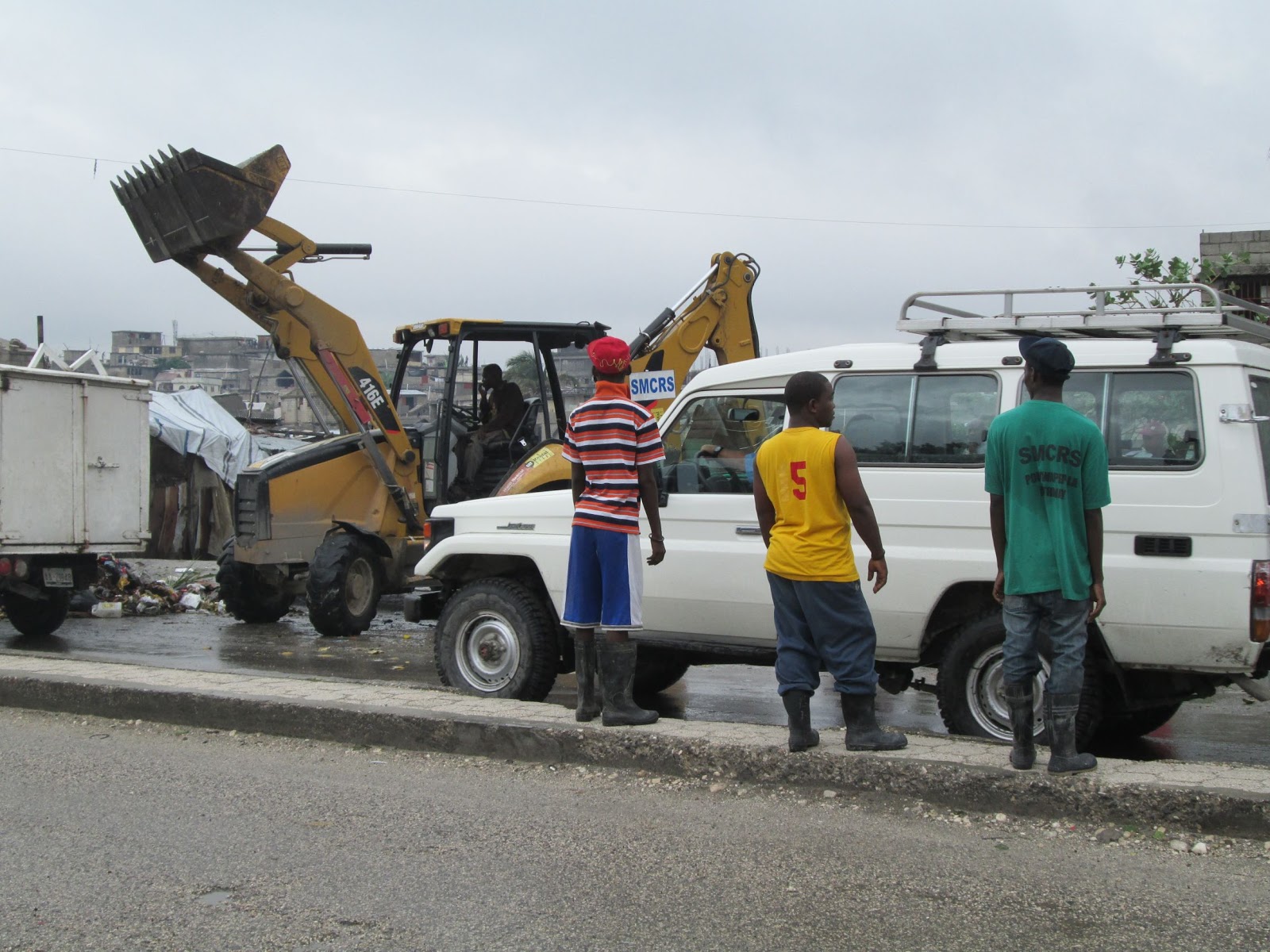
This was the clean up scene near the canal on the Piste road near Airport Rd.

We were thankful that the Timothy Training Seminars held at the Christian Reformed Ministry Centre were not cancelled.

Eryl enjoyed helping out to bring food to those participating in the seminars that Coram Deo sponsored.

Friday afternoon we brought the pastors and church workers to the bus station for those who lived in the mountains of Kenscoff area.

They didn't realize how bad it was because they passed their days at the Ministry Centre. Pastor Pierre's church was destroyed by the storm and some of these people couldn't get to their homes because of the storm damage. They ended up staying the night at Pastor Pierre's home.

It was great to see how medical personnel continued to work through the storm. Jonathan Delbrice is a boy who broke his arm about 6 weeks ago while he was in the countryside with family. He was one of the first group of people who attended Ed Amos's first medical clinic here at our house. We brought him to Adventist Hospital and xrays were taken of his right lower arm. As shown in this xray both of his lower arm bones were broken. Surgery to reset the bones was made for Thursday.

The hospital came and picked up Jonathan and his mother. His surgery that was originally scheduled for Thursday was done on Friday morning. During the surgery the doctors aligned the bones, put a plate in place and anchored the plate to the bone with pins.

He has an appointment to come back in one month.

Jonathan and his mother were happy to get the surgery... during stormy conditions. We are grateful to the medical personnel who carried through with the surgery. The surgery was free. The only cost was for antibiotics, which came to $100H ($12 US). We are thankful too to those working with Cure International at Adventist Hospital in Carrefour. This family would not have been able to find surgery for their son without their efforts. Pray for healing for Jonathan and that he has full use of his arm.

The neurosurgery team from the University of Miami flew to Haiti on Thursday, knowing that they would be coming to tropical storm conditions. They saw the children that afternoon and admitted the babies who would receive surgery at Bernard Mevs/Project Medishare Hospital.

When we brought food to the hospital we visited the mothers and their babies.

This young girl is 2-years-old.

This bulge at the back of this baby's head will be removed. Brain tissue protrudes through an opening in the skull.

This mother is hopeful that the baby can have a more normal life with a surgery. The baby is young, only 1 month old.

This mother wanted a picture taken with her daughter.

The mother's are all hopeful that with a surgery the lives of their children will improve.

Pray for the children who will be receiving surgery.

Pastor Marcelins'' sister-in-law lives in Jean Rabel. She became sick and the family brought her to Port-au-Prince. She was hospitalized at St. Philomene Hospital in Tabarre. Doctors there told her that she needed to see a urinary specialist at General Hospital. Friday morning the family called and said that she did not have a bed and was laying on the floor in the emergency room. We went and picked up Pastor Marcelin and brought a cot to General Hospital.

The emergency room was being renovated. Painting was being done. The patients did not have much room. Amos's aunt has kidney problems and was having trouble urinating.

This is where she was lying. We put a cot in place so that she wouldn't have to lay on the floor.

General Hospital was heavily damaged during the earthquake. Demolition of damaged buildings is being done. This is a view of the Orthopedic/Trauma building which is next to the emergency building.

This is a view of the front of the Orthopedic building.

The building used to be 3 stories. The United States and France are funding the reconstruction/renovation work being done at General Hospital.

An American specialist in infectious diseases still maintains the TB unit at General Hospital. Her name is Dr. Coffee. The unit is outdoors. Part of the unit is a pre-fab building.

Shelter Box tents are also used as isolation areas for patients.

We visited the pediatrics area. The pediatrics building has been demolished and these temporary structures will house the pediatrics unit until a new pediatrics building is constructed. Pray for all those who work during the storms and for those who are now without shelter here in Haiti. Once again the country is suffering a natural disaster, this time caused by Hurricane Sandy.
Subscribe to:
Posts (Atom)